With his delicate drawings and surreal themes, Armando Veve creates illustrations for large magazines and brands all around the world. Based in Philadelphia, the artist and illustrator designs subtle pieces that he displays on his website or on his Instagram account.
With his delicate drawings and surreal themes, Armando Veve creates illustrations for large magazines and brands all around the world. Based in Philadelphia, the artist and illustrator designs subtle pieces that he displays on his website or on his Instagram account.
With his delicate drawings and surreal themes, Armando Veve creates illustrations for large magazines and brands all around the world. Based in Philadelphia, the artist and illustrator designs subtle pieces that he displays on his website or on his Instagram account.
Every week, we’ll give you an overview of the best deals for designers, make sure you don’t miss any by subscribing to our deals feed. You can also follow the recently launched website Type Deals if you are looking for free fonts or font deals.
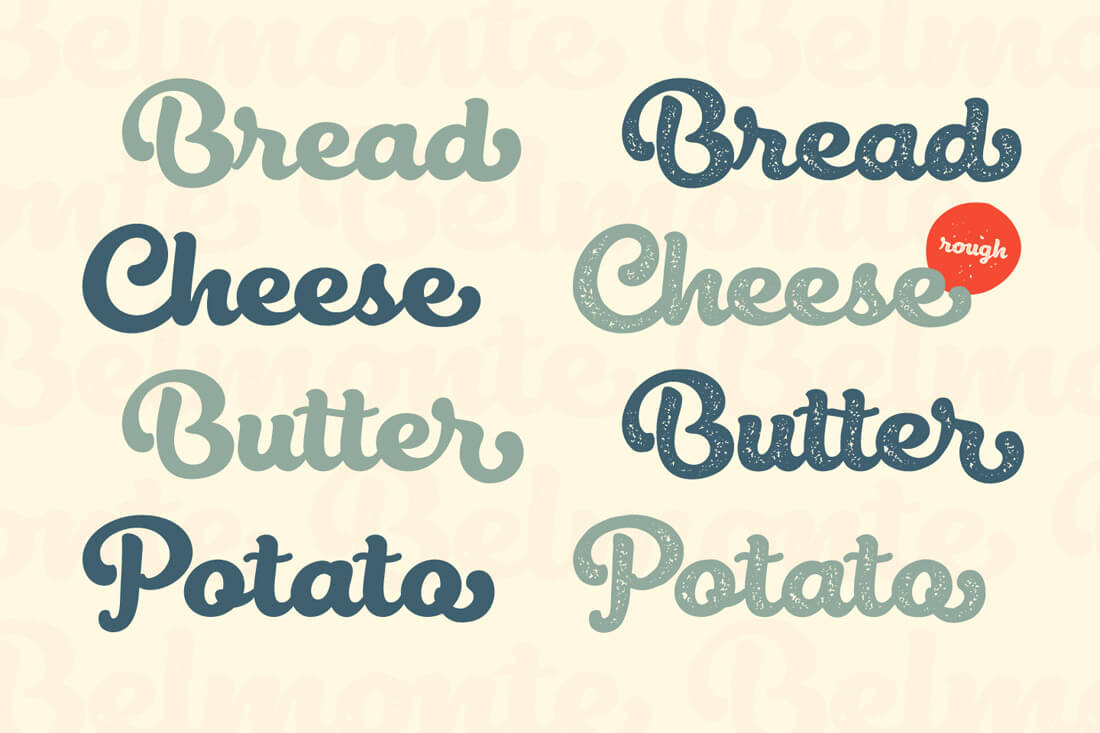
Belmonte, Delicious Bold Script Font
Belmonte, a sweet, bold, delicious and crunchy script font comes packed with several OpenType features including stylistic alternates, standard ligatures, stylistic sets and swashes. Besides a clean style, there’s also a rough one to give off a vintage vibe. This bold bad boy is perfect for food branding and product packaging typography.
65+ Textless Vector Illustrations for T-shirts, Posters, Logos
Spice things up in your latest designs with this collection of 67 vector illustrations without text. They’re perfect for everything from T-shirts to posters to logos, and cover categories like animals, abstract, linear beauty and retro girls. With an extended license, the sky is your design limit.
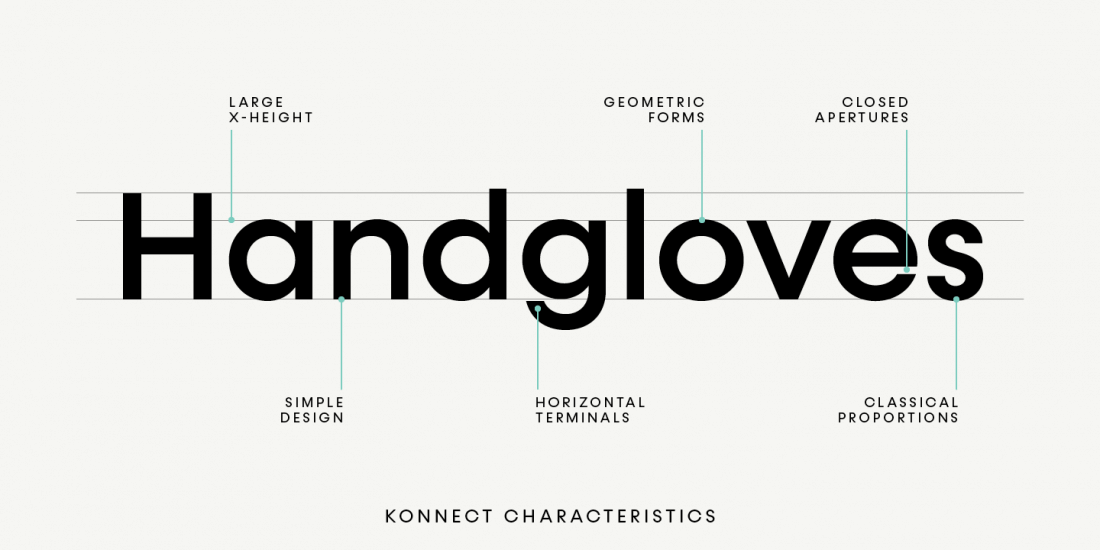
Konnect is a geometric sans serif type family featuring a blend of modern, classical, and playful characteristics. With 9 different weights, each available in regular and italics, it’s like getting 18 different fonts in 1. Besides 600+ glyphs and multi-language support, you’ll also get multiple swashes, stylistic alternates, and arrow icons to enhance your typography.
Whether you’re just starting out or need to give your ecommerce site a boost, the Designing Ecommerce Websites eBook by Matt Isherwood is here to help. Packed with 66 detailed guidelines, this reference offers step by step instructions to walk you through every step of the shopping funnel from landing pages to checkout.
Konya is a signature script-style font with a very luxurious look. Perfect for branding, the typeface comes equipped with a number of alternates that allow you to create various logos, plus some swash to add to the firmness of signature.
This resource-packed Artistic Bundle features 2,800 different brushes, add-ons and graphic elements in 1 deeply discounted deal. Snag a wide range of brushes for Photoshop, Illustrator and procreate, along with loads of creative patterns, graphic elements and styles. From golden seamless patterns to fabric styles, you’re sure to up your design game with this collection.
Every week, we’ll give you an overview of the best deals for designers, make sure you don’t miss any by subscribing to our deals feed. You can also follow the recently launched website Type Deals if you are looking for free fonts or font deals.
Belmonte, Delicious Bold Script Font
Belmonte, a sweet, bold, delicious and crunchy script font comes packed with several OpenType features including stylistic alternates, standard ligatures, stylistic sets and swashes. Besides a clean style, there’s also a rough one to give off a vintage vibe. This bold bad boy is perfect for food branding and product packaging typography.
65+ Textless Vector Illustrations for T-shirts, Posters, Logos
Spice things up in your latest designs with this collection of 67 vector illustrations without text. They’re perfect for everything from T-shirts to posters to logos, and cover categories like animals, abstract, linear beauty and retro girls. With an extended license, the sky is your design limit.
Konnect is a geometric sans serif type family featuring a blend of modern, classical, and playful characteristics. With 9 different weights, each available in regular and italics, it’s like getting 18 different fonts in 1. Besides 600+ glyphs and multi-language support, you’ll also get multiple swashes, stylistic alternates, and arrow icons to enhance your typography.
Whether you’re just starting out or need to give your ecommerce site a boost, the Designing Ecommerce Websites eBook by Matt Isherwood is here to help. Packed with 66 detailed guidelines, this reference offers step by step instructions to walk you through every step of the shopping funnel from landing pages to checkout.
Konya is a signature script-style font with a very luxurious look. Perfect for branding, the typeface comes equipped with a number of alternates that allow you to create various logos, plus some swash to add to the firmness of signature.
This resource-packed Artistic Bundle features 2,800 different brushes, add-ons and graphic elements in 1 deeply discounted deal. Snag a wide range of brushes for Photoshop, Illustrator and procreate, along with loads of creative patterns, graphic elements and styles. From golden seamless patterns to fabric styles, you’re sure to up your design game with this collection.
Every week, we’ll give you an overview of the best deals for designers, make sure you don’t miss any by subscribing to our deals feed. You can also follow the recently launched website Type Deals if you are looking for free fonts or font deals.
Belmonte, Delicious Bold Script Font
Belmonte, a sweet, bold, delicious and crunchy script font comes packed with several OpenType features including stylistic alternates, standard ligatures, stylistic sets and swashes. Besides a clean style, there’s also a rough one to give off a vintage vibe. This bold bad boy is perfect for food branding and product packaging typography.
65+ Textless Vector Illustrations for T-shirts, Posters, Logos
Spice things up in your latest designs with this collection of 67 vector illustrations without text. They’re perfect for everything from T-shirts to posters to logos, and cover categories like animals, abstract, linear beauty and retro girls. With an extended license, the sky is your design limit.
Konnect is a geometric sans serif type family featuring a blend of modern, classical, and playful characteristics. With 9 different weights, each available in regular and italics, it’s like getting 18 different fonts in 1. Besides 600+ glyphs and multi-language support, you’ll also get multiple swashes, stylistic alternates, and arrow icons to enhance your typography.
Whether you’re just starting out or need to give your ecommerce site a boost, the Designing Ecommerce Websites eBook by Matt Isherwood is here to help. Packed with 66 detailed guidelines, this reference offers step by step instructions to walk you through every step of the shopping funnel from landing pages to checkout.
Konya is a signature script-style font with a very luxurious look. Perfect for branding, the typeface comes equipped with a number of alternates that allow you to create various logos, plus some swash to add to the firmness of signature.
This resource-packed Artistic Bundle features 2,800 different brushes, add-ons and graphic elements in 1 deeply discounted deal. Snag a wide range of brushes for Photoshop, Illustrator and procreate, along with loads of creative patterns, graphic elements and styles. From golden seamless patterns to fabric styles, you’re sure to up your design game with this collection.
I think those classifications are handy, and help conversations along. But there is a point where nuance is necessary and these classification buckets get a little leaky.
Note, these charts are just intended to paint a spectrum, not to be a comprehensive list of services.
Headless CMSs
A Headless CMS is a CMS that provides an admin area for creating and editing content, but offers no front-end to build the website from. All the content is accessed via APIs.
Imagine WordPress, which has an admin area, but it also has themes from which you build the website from on the server-side, with all kinds of PHP functions for you to use the content data. All that theming stuff is the „head”. So a headless CMS would be like WordPress with just the admin area. And indeed you can use it that way, as it offers APIs.
There is even more nuance here, as there are services that offer an admin area, but don’t actually store the data for you. Plus there is CMSs that are hosted for you, and CMSs where you have to bring your own hosting. Let’s have a peak.
This is tricky to talk about because literally, any web host will host static files, and probably do an OK job of it. I think it’s most useful to consider hosts that only do static hosting on purpose because it means they can optimize for that situation do other useful things.
Sometimes you’ll see people trying to use stuff like Dropbox or Google Drive to do static file hosting (for a website), but I’ve found these services generally ultimately don’t like that and prevent the use for that. If it works today, fine, but I wouldn’t count on any of them long term.
Static Site Generators
You would think this category would be straightforward, without much spectrum. A static site generator takes input and makes statically generated pages that can render without, say, needing to hit a database. But even here there is a spectrum.
The language the generator is in kinda matters. It affects speed. It affects installability on different local platforms. It affects your ability to write code to extend it and hack on it.
But perhaps more importantly, not all static site generators are only static site generators. Some can be run on the server as well, weirdly enough. And there are some that kinda look like static site generators, but are more correctly classified as flat-file CMSs.
Gatsby is truly a static site generator, but generally, the sites „hydrate” into SPAs, but remain static (nothing server-rendered). Big ecosystem of plugins to help with connecting data sources, handling images, etc.
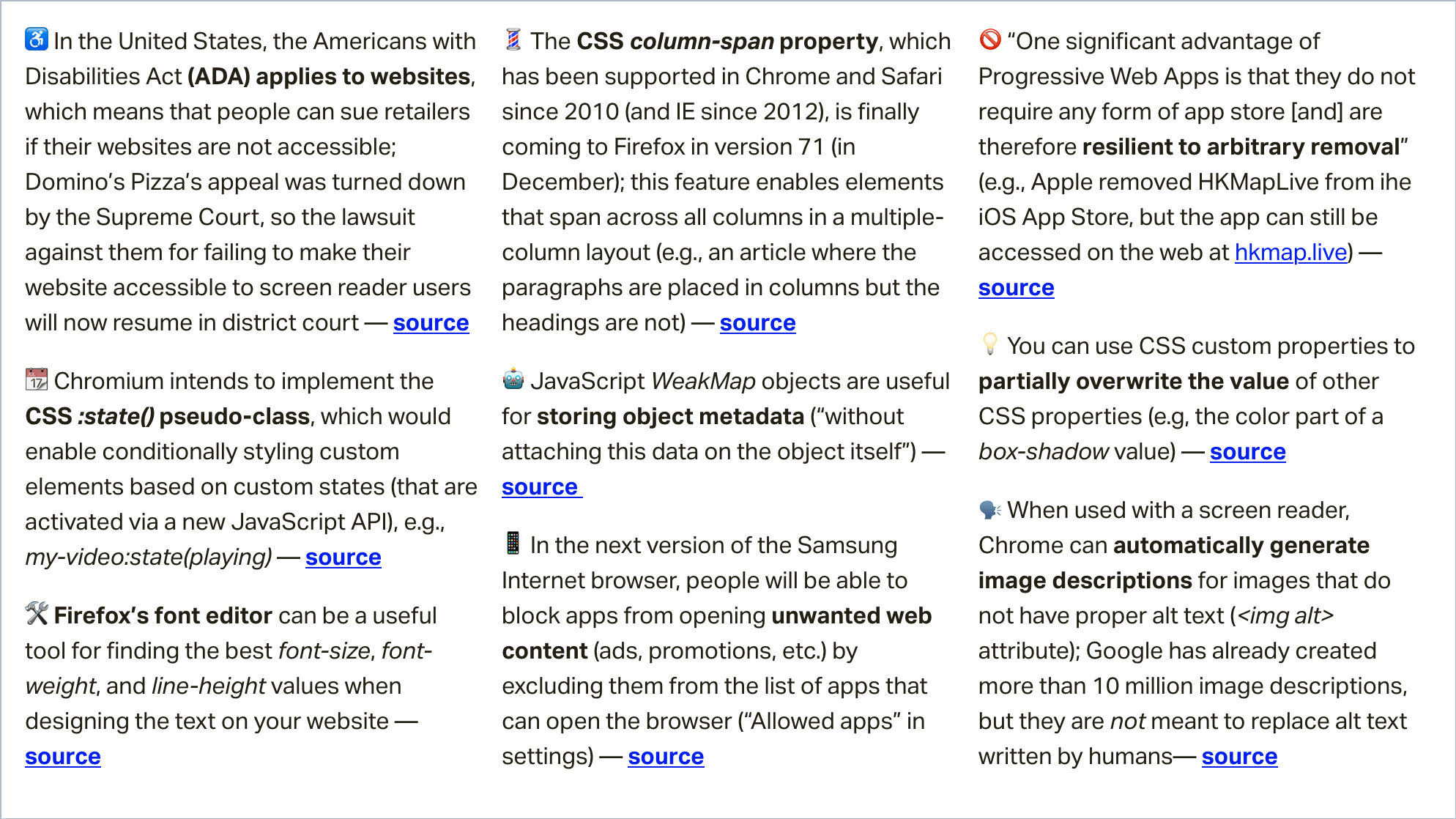
In this week’s roundup: multi-column layouts gain wide support, the ADA means more A11y for retailers, and Google is doing something about all the empty image alt attributes in the wild.
The CSS column-span property will soon be widely supported
The CSS column-span property, which has been supported in Chrome and Safari since 2010 (and IE since 2012), is finally coming to Firefox in version 71 (in December).
This feature enables elements that span across all columns in a multiple-column layout. In the following demo, the headings span across both columns.
The Americans with Disabilities Act applies to websites
In the United States, the Americans with Disabilities Act (ADA) applies to websites, which means that people can sue retailers if their websites are not accessible.
Domino’s Pizza’s appeal was recently turned down by the Supreme Court, so the lawsuit against them for failing to make their website accessible to screen reader users will now resume in district court.
Guillermo Robles, who is blind, filed suit in Los Angeles three years ago and complained he had been unable to order a pizza online because the Domino’s website lacked the software that would allow him to communicate. He cited the ADA, which guarantees to people with a disability “full and equal enjoyment of the goods and services … of any place of public accommodations.”
Google announces automatically generated image descriptions for Chrome
When used with the VoiceOver screen reader, Chrome can now automatically generate image descriptions for images that do not have proper alt text (<img alt> attribute). Google has already created more than 10 million image descriptions, but they are not meant to replace alt text written by humans.
Image descriptions automatically generated by a computer aren’t as good as those written by a human who can include additional context, but they can be accurate and helpful.
This new accessibility feature, called “Accessibility Image Descriptions,” may not be enabled by default in your version of Chrome, but you can enable it manually on the chrome://flags page.
There are loads of analytics platforms to help you track visitor and usage data on your sites. Perhaps most notably Google Analytics, which is widely used (including on this site), probably due to it’s ease of integration, feature-richness, and the fact that it’s free (until you need to jump up to the enterprise tier which is some crazy six-figure jump).
I don’t take any particular issue with Google Analytics. In fact I quite like it, especially as I’ve learned more about customizing it, like we’ve done here on CSS-Tricks as well as on CodePen.
But there are other options. In particular, I wanted to look at some other options where:
You can self-host the analytics. Always something to be said for owning your own data.
Data collection doesn’t require JavaScript. That’s so often blocked these days, as wariness of third-party JavaScript grows. It’s interesting to consider the entirely unobtrusive server-log based analytics.
I didn’t find a sea of options to look at. The classic one I always think of in this category is Shaun Inman’s Mint, but Mint isn’t taking new customers anymore. Maybe I’m not looking in all the right places, and perhaps you can help with that. Please chime in with a comment if you know of more options — especially ones you have experience with.
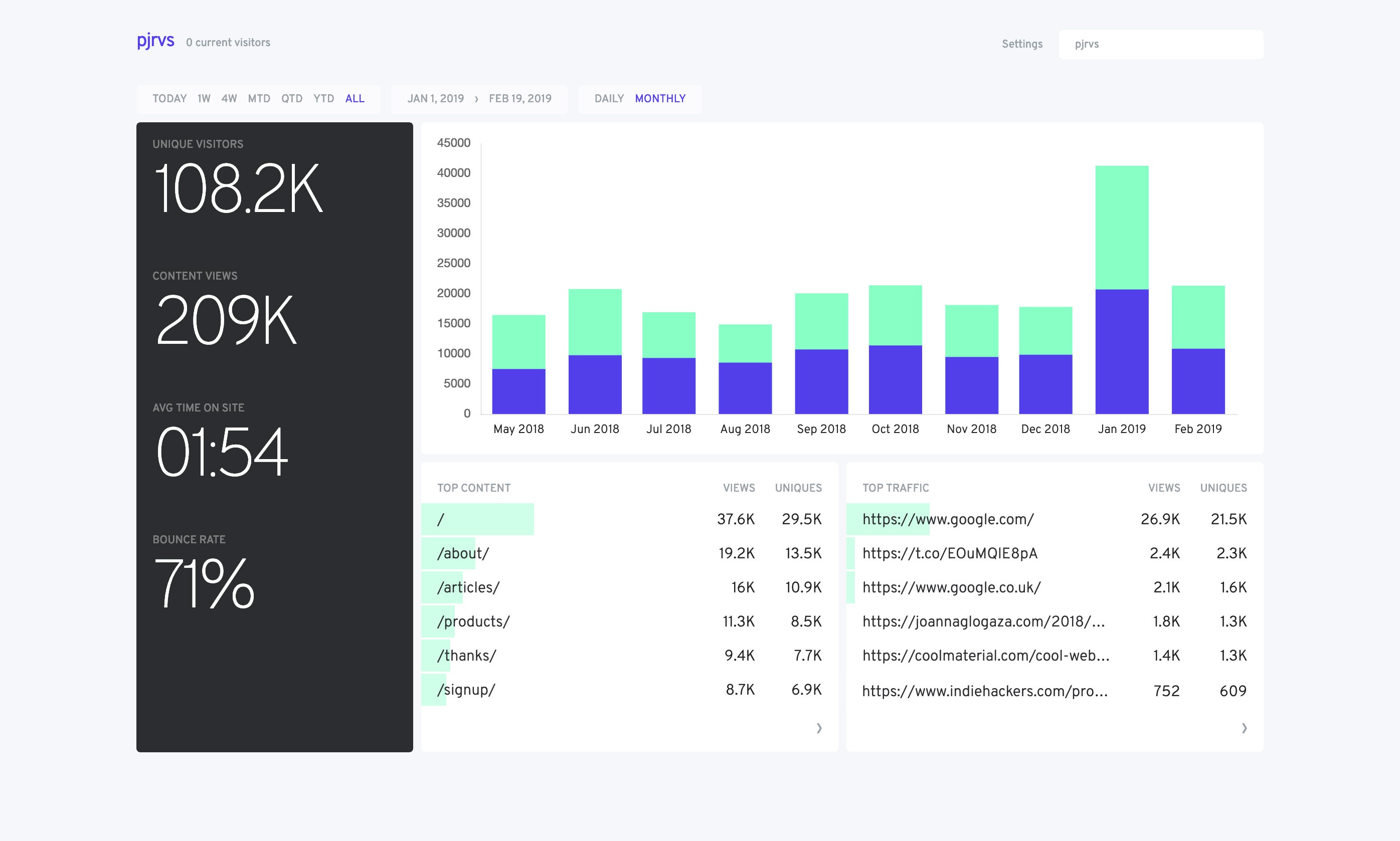
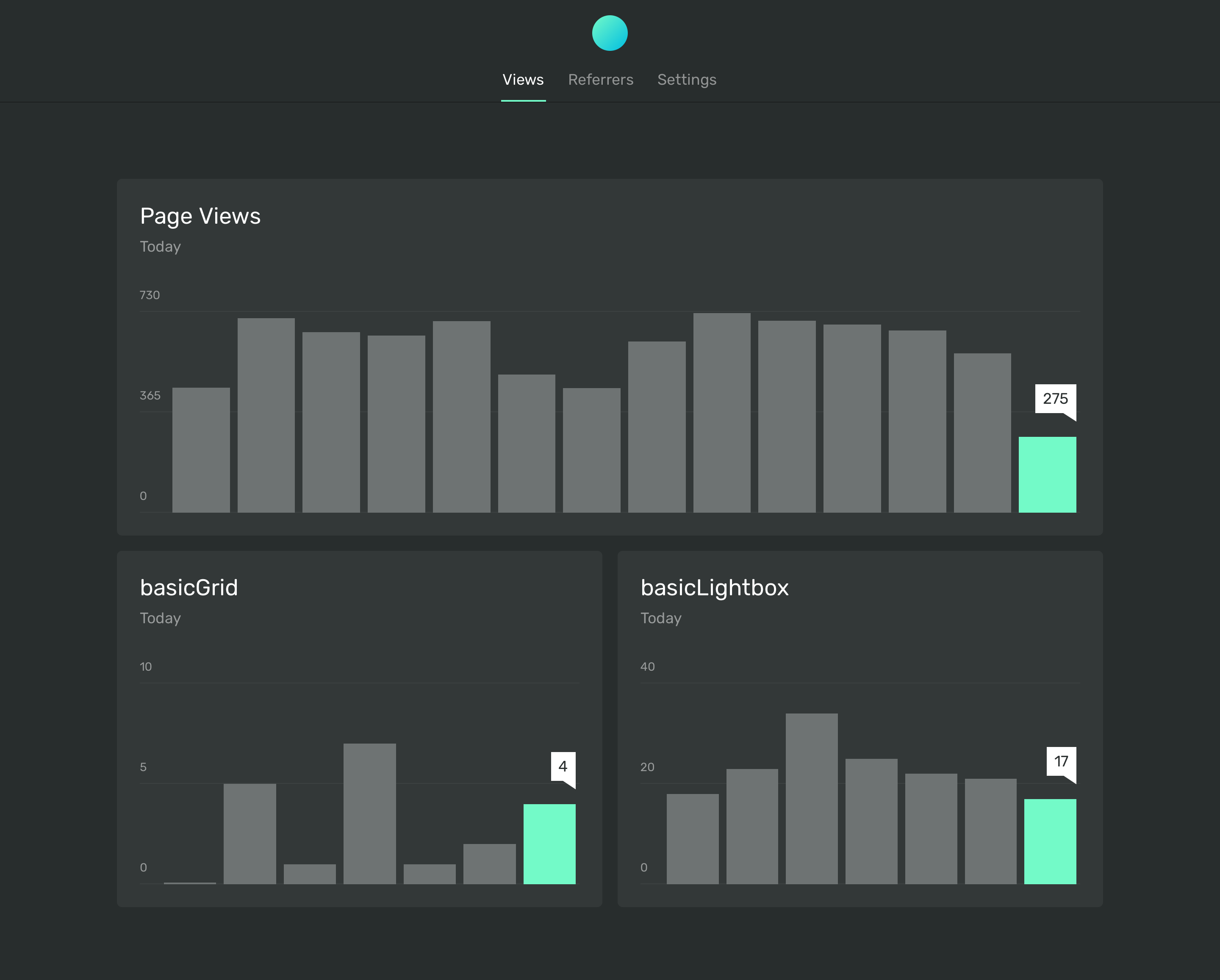
This is one Dave Rupert uses on his personal site and has written about. They have a paid hosted version, which is still focused on privacy in the sense that it does not track or store user data. But they also have a free self-hosted version you can run on your own. Actual data collection is done via a JavaScript snippet you put into your site.
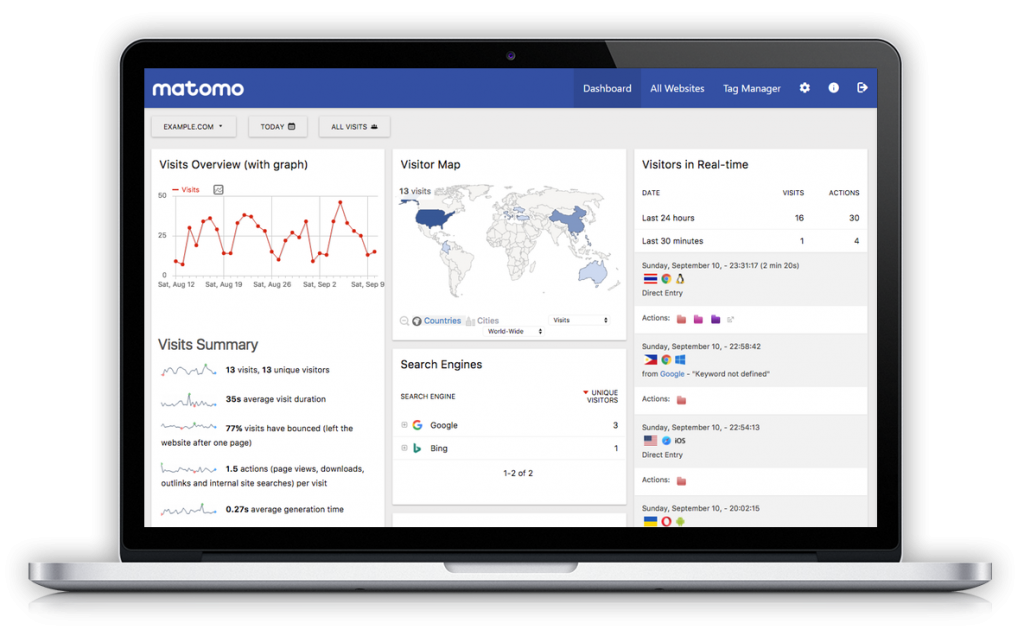
Matomo Cloud is their hosted version, and On-Premisis is the self-hosted version. The actual data collection is done via a JavaScript snippet you put into the site.
I personally use matomo for my side projects. Its vast and getten me fall into love. ✌
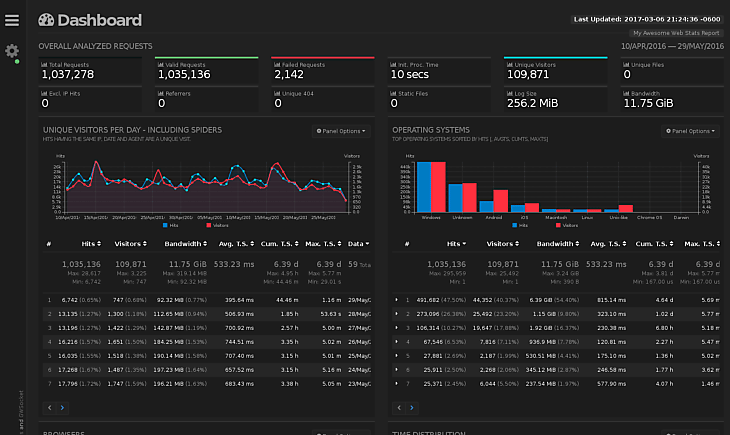
GoAccess is notable because it’s the first in the list that is a „web log analyzer” which means it looks at access logs that your web server creates rather than relying on JavaScript reporting from the client side. Theoretically, this should be more accurate since client-side JavaScript can be blocked. GoAccess generates reporting that can be viewed in the terminal, as well as browser-based charts and graphs.
I use GoAccess as a static site generated on a cronjob (https://t.co/yiQMev7NDu) which seems to work quite nicely for very basic site. Doesn’t (afaik) handle ignoring spiders etc
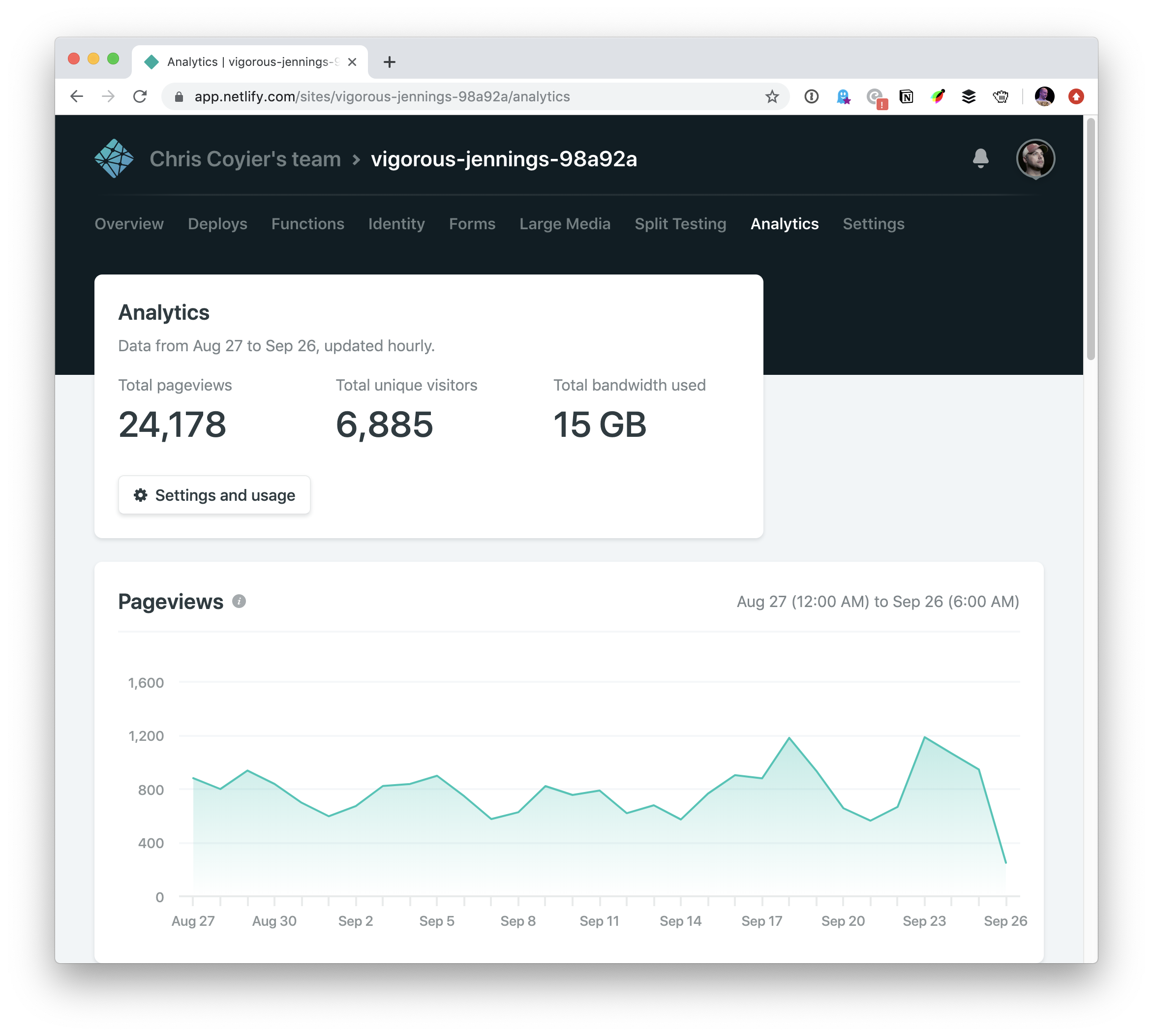
Netlify Analytics isn’t self-hosted in that you install it yourself on servers you rent. A big point of using Netlify is that it prevents you from dealing with your own servers. The analytics are server-log based rather than JavaScript which can be desirable as they are likely more accurate and don’t impact performance.
Web hosts are uniquely qualified to offer analytics to their users as they configure their own logging and such. For example, I also have analytics on this site through Flywheel, without installing anything, because they can analyze the traffic going through their servers. We wrote up an overview of the service when it was released.
AWStats is the oldest analytics tool on the block. When I started out on the web, all the web hosting providers touted AWStats dashboards as part of their offerings. It runs on Perl, and like the last two services above, it gets data from server logs.
It ain’t pretty but it’s free, open-source, and has the stability of being a software project nearly 20 years old.
There are loads of analytics platforms to help you track visitor and usage data on your sites. Perhaps most notably Google Analytics, which is widely used (including on this site), probably due to it’s ease of integration, feature-richness, and the fact that it’s free (until you need to jump up to the enterprise tier which is some crazy six-figure jump).
I don’t take any particular issue with Google Analytics. In fact I quite like it, especially as I’ve learned more about customizing it, like we’ve done here on CSS-Tricks as well as on CodePen.
But there are other options. In particular, I wanted to look at some other options where:
You can self-host the analytics. Always something to be said for owning your own data.
Data collection doesn’t require JavaScript. That’s so often blocked these days, as wariness of third-party JavaScript grows. It’s interesting to consider the entirely unobtrusive server-log based analytics.
I didn’t find a sea of options to look at. The classic one I always think of in this category is Shaun Inman’s Mint, but Mint isn’t taking new customers anymore. Maybe I’m not looking in all the right places, and perhaps you can help with that. Please chime in with a comment if you know of more options — especially ones you have experience with.
This is one Dave Rupert uses on his personal site and has written about. They have a paid hosted version, which is still focused on privacy in the sense that it does not track or store user data. But they also have a free self-hosted version you can run on your own. Actual data collection is done via a JavaScript snippet you put into your site.
Matomo Cloud is their hosted version, and On-Premisis is the self-hosted version. The actual data collection is done via a JavaScript snippet you put into the site.
I personally use matomo for my side projects. Its vast and getten me fall into love. ✌
GoAccess is notable because it’s the first in the list that is a „web log analyzer” which means it looks at access logs that your web server creates rather than relying on JavaScript reporting from the client side. Theoretically, this should be more accurate since client-side JavaScript can be blocked. GoAccess generates reporting that can be viewed in the terminal, as well as browser-based charts and graphs.
I use GoAccess as a static site generated on a cronjob (https://t.co/yiQMev7NDu) which seems to work quite nicely for very basic site. Doesn’t (afaik) handle ignoring spiders etc
Netlify Analytics isn’t self-hosted in that you install it yourself on servers you rent. A big point of using Netlify is that it prevents you from dealing with your own servers. The analytics are server-log based rather than JavaScript which can be desirable as they are likely more accurate and don’t impact performance.
Web hosts are uniquely qualified to offer analytics to their users as they configure their own logging and such. For example, I also have analytics on this site through Flywheel, without installing anything, because they can analyze the traffic going through their servers. We wrote up an overview of the service when it was released.
AWStats is the oldest analytics tool on the block. When I started out on the web, all the web hosting providers touted AWStats dashboards as part of their offerings. It runs on Perl, and like the last two services above, it gets data from server logs.
It ain’t pretty but it’s free, open-source, and has the stability of being a software project nearly 20 years old.